The Fundraising CRM You Should Build 6 Months Before You Need It
Six months from your raise. A grant deadline is coming. The team needs you. And somewhere in the back of your mind, a quiet dread is building, because you know what fundraising takes and you have not started yet.
Not really. You have had some conversations. Met some people at events. Said yes when someone offered to make an introduction. But you cannot tell anyone, including yourself, where any of those conversations stand. Who you spoke to. What they said. What you promised to follow up on. Whether any of it is still warm.
That is not a focus problem. That is a systems problem. And it does not get better when the round opens. It gets worse.
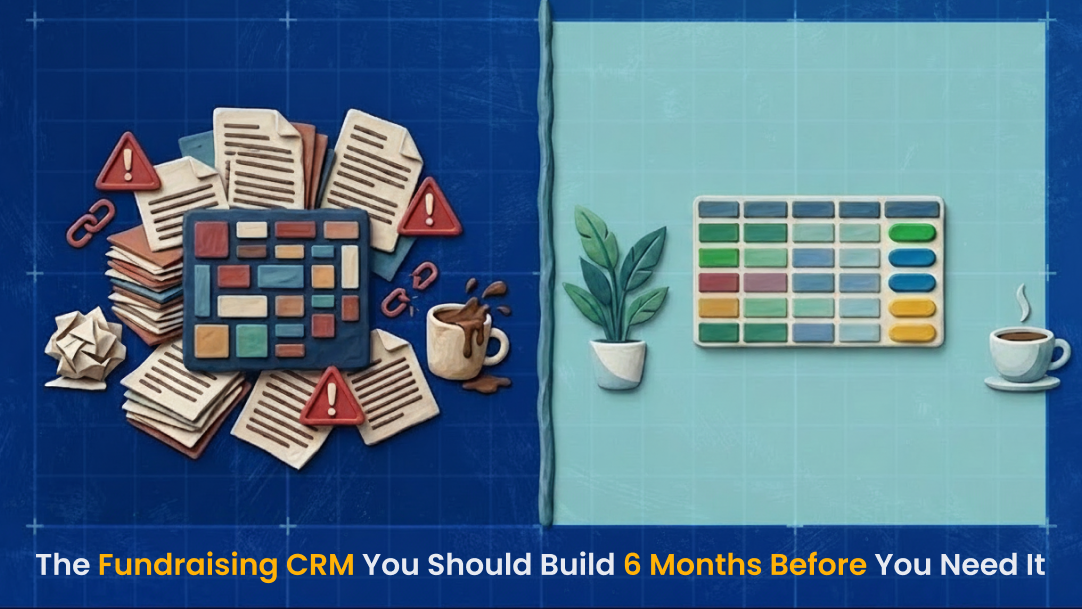
A fundraising CRM is not a spreadsheet. It is the difference between a raise that compounds and one that starts from zero every time.
Most founders think a CRM means more admin. It does not. It means less chaos.
A fundraising CRM is a single place where every investor relationship lives. Who they are, what they actually invest in, what happened in every conversation, what you promised to do next and where they sit in your pipeline right now. Not scattered across inboxes, notebooks and memory. In one place, with context, so every conversation builds on the last one instead of starting over.
Without it, fundraising is reactive. You are chasing people you half-remember, rebuilding context you already had and losing momentum every time a follow-up slips. With it, fundraising becomes a process. One you can run with intention while still running the company.
The founders who close rounds efficiently are not better at pitching. They are better organised before the pitch ever happens.
Ryan DuChanois of Solidec described going through his raise with nothing but a spreadsheet, notes from every meeting, transferred by hand every evening after a full day of pitching. It worked. But the cost was enormous. "A CRM for investors, when I go raise my next round, that is how I am going to do it," he said. "I am not going to use Excel anymore."
That is the shift. From surviving a raise to running one.
Every event, introduction and coffee meeting is a future data point. Most founders lose them.
Every accelerator cohort. Every pitch competition. Every conference. Every warm introduction. Each one has the potential to become part of a future raise.
Most founders have no system for capturing any of it. Notes live in email threads. Introductions disappear in messaging apps. Six months later the context is gone. You remember the conversation but not what the investor cared about, what you said you would send or what they asked you to come back with.
One founder we spoke to was using HubSpot throughout their raise. Still, someone fell through the cracks. Not because the tool was bad but because no generic CRM surfaces the right reminder at the right stage of a fundraise. It surfaces activity by recency. That is not the same thing.
When fundraising begins, relationships that could have been nurtured over months have to be rebuilt from scratch. In a raise where momentum is everything, that is expensive.
The five things that separate a warm pipeline from a cold one
The tool matters less than the information inside it. Before a raise begins, track five things for every investor in your ecosystem.
Who they are and what they actually invest in. Not what their website says but what their portfolio reveals about their real thesis, stage and check size.
As Jeff Wolfe put it after decades of raising capital in clean energy: "More often than not the investment thesis is aspirational, not actual."
What happened in every conversation. The questions they asked, the concerns they raised, what they asked you to come back with. An investor who raised a concern in February and hears you address it precisely in May feels listened to. That matters more than most founders realise.
What you committed to do next. Every promise made in a meeting that has no owner is a relationship quietly going cold. If it is not tracked, it does not happen.
When you last spoke and when to reconnect. Communication velocity is one of the clearest signals of investor interest and it runs both ways. An investor who has not heard from you in six weeks has started to forget you.
Where they sit in your pipeline. There is a significant difference between someone who took your first call and someone who has asked for your cap table. Treating them the same way is a mistake most first-time founders only make once.
Building under pressure is the most expensive way to build
Picture a Tuesday afternoon mid-raise. You have four investor calls today. Between the second and third you get a message from someone you met three months ago asking if you are still raising. You cannot remember what you told them last time. You scroll through emails looking for the thread. You find it but there are no notes on what they said or what you promised to follow up on. You send a vague reply and hope it lands.
Meanwhile the third call is in ten minutes and you have not looked at their portfolio yet.
That is not a bad day. That is what every day looks like when the system does not exist before the raise starts.
Six months of relationship tracking before a raise changes everything. The investor list is already qualified. Follow-ups are already consistent. Updates are already going out. When the round opens, you are not starting from zero. You are activating something that has been building in the background.
Jeff Wolfe kept a running investor spreadsheet throughout every raise with notes on every conversation. "You want their help," he said. "Sometimes they make an introduction and then the person goes quiet. You need to know whether they are just busy or whether something changed."
That kind of visibility is only possible if the system exists before the noise starts.
The founders who close rounds are not better prepared during the raise. They were better prepared before it.
The fear, the anxiety, the dread of starting a raise with nothing organised is not inevitable. It is the result of treating fundraising as something that starts when you decide to raise.
The founders who avoid it do one thing differently. They treat every investor conversation, every introduction, every update they send as part of an ongoing process that never really stops. Not because they are always fundraising but because they know that when the moment comes, the work will already be done.
Readiness means knowing which investors are genuine fits before you ever pitch them. It means having context from every previous conversation readily available. It means being able to send a relevant update to the right person at the right time without scrambling through old emails.
Rawand Rasheed, PhD of Helix Earth described maintaining relationships with investors for three years before some of them wrote a check. "Investors invest in lines, not dots," he said. "If somebody sees you today they put a dot on the plot. They see you six months later and they can connect those points and draw a line."
The strongest fundraising processes rarely begin when the round opens. They begin months earlier.
Which is exactly why the most valuable system you will ever build is the one you start today.
At Cephyron, we built our platform around exactly this problem, helping founders track investor conversations, manage follow-ups and build fundraising readiness before the raise becomes urgent, with investor intelligence embedded directly in the workflow so you are always working toward the right conversations, not just more of them.
If you are six months from your raise and want to see how it works, book a demo.
Related Articles:
- The Investor Update You Should Be Sending Before Anyone Asks — Cephyron
- You Aren't Actually Fundraising Until You've Done These 7 Things First — Cephyron
- How to Build Investor Relationships Before You Need Them — Forum Ventures
- How to Build Venture Capital Relationships Before Raising — Qubit Capital
- Managing Your Fundraise — Y Combinator