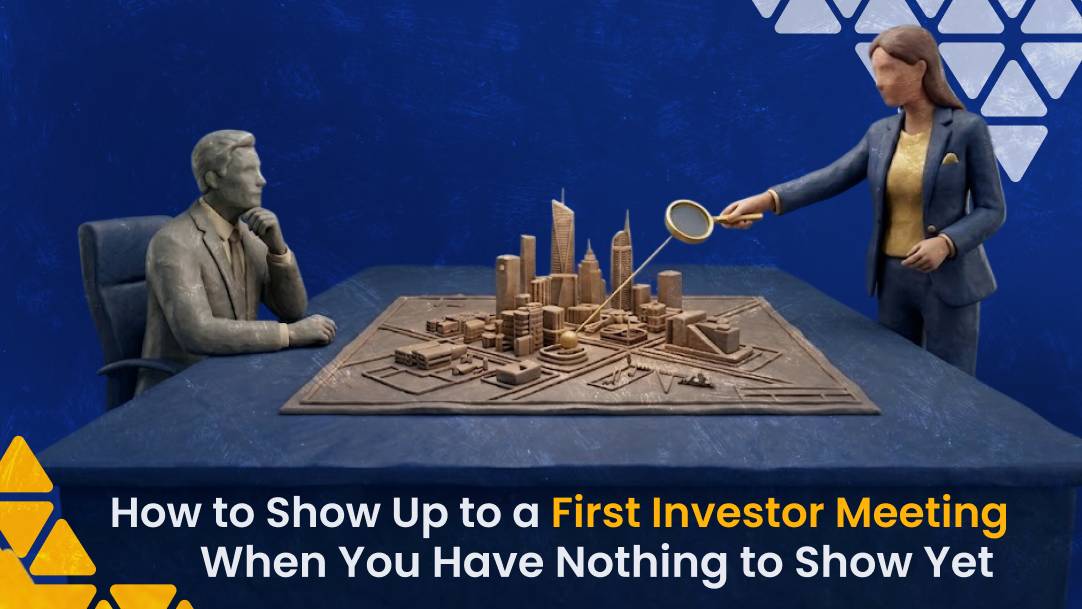
How To Show Up to a First Investor Meeting When You Have Nothing to Show Yet
Most first-time founders walk into their first investor meeting carrying the same fear: I don't have enough to show.
No product. No traction. No deck that feels finished. And underneath all of it, the worry that an investor will see straight through them.
That fear is understandable. It is also based on a misreading of what the meeting is actually for.
One goal, and it is not funding
A first investor meeting is a screening conversation on both sides. The investor is trying to assess whether the founder's thinking is worth more of their time. The founder should be doing the same in reverse.
Most founders treat it as a pitch. The ones who do well treat it as the first conversation in what they hope will be a longer relationship. The goal is a follow-up meeting. Investors know you are early. They took the meeting because something caught their attention. Your job is to confirm that their attention was warranted.
Walk out with a scheduled next step and the meeting worked.
What you have, even before you have built anything
Rawand Rashid of Helix Earth spent years refining his pitch before he understood what was actually moving investors. The results shifted when he stopped leading with the product and started leading with the person behind it.
"People invest in other people more than technology, more than the mission," he said. "They are interested in the people behind it."
For academic and technical founders this matters more than most realise. The way you were trained to think is an asset in that room. Documenting progress under uncertainty, communicating results before they are complete, being able to say we do not know yet and here is how we will find out without flinching, that is exactly the judgment investors are trying to assess in an early meeting. Most founders perform confidence they do not have. Founders who come from research backgrounds are often better at showing genuine rigour, which is harder to fake and more valuable to an investor trying to assess a long bet.
When there is nothing built yet, your thinking is the product.
The three things your thinking has to demonstrate
Before you have traction, clarity becomes your strongest signal. Not confidence. Not polish. Clarity on three things.
Problem clarity: Not just what problem you are solving but who feels it most acutely, how they are living with it today, and why every existing solution falls short. Investors at this stage are evaluating how deeply you understand the world your product has to live in.
Insight clarity: Insight is not a feature idea. It is a belief about why now — what has shifted in the market, technology, or customer behavior that makes this moment different from three years ago. Without a named shift, the opportunity reads either early or late.
Direction clarity: Even without a product you should be able to say what you are testing next, what you expect that test to prove, and what success looks like in three to six months. It is evidence that you are not just exploring. You are executing thought.
What to prepare
Three things matter before a first investor meeting.
A plain description of what you do. One sentence, no jargon, no vision statement. Something a person outside your industry could repeat an hour later. Ryan DuChanois of Solidec went through roughly fifty versions of his elevator pitch before it felt right. "After you do it a hundred times you find what works and what does not,"
A specific answer to why now. Not a belief that the market is ready but a concrete explanation of what shifted recently. Investors hear the timing is right constantly. They remember the founder who can name the specific thing that changed.
One informed question for the investor. Read their portfolio before the meeting. Find the company that looks most like yours and ask about it. That question signals more about your judgment than most of what is in a deck.
On confidence
Ryan DuChanois noticed something early about investor feedback.
"Some of the most honest feedback we got was when we were not raising, because it just lets everyone's guard down."
There is a lesson in that. The founders who get the most out of first meetings are not performing conviction. They are having an actual conversation, asking real questions, sharing what they know, being direct about what they do not.
Confidence in an early investor meeting is not about having answers. It is about being clear on what you know, honest about what you do not, and specific about how you will close the gap. Investors have seen enough rehearsed pitches to recognise one. What stays with them after the meeting is a founder who was grounded, direct, and structured in how they thought through hard questions. The more a founder performs certainty they do not have, the less credible they become.
The question running in every investor's mind is simple: do I believe this person will figure it out? Everything you say should make that question easier to answer yes to.
At Cephyron, we help founders prepare for exactly these conversations. Tracking investor interactions, managing follow-ups, and staying organised from the first meeting through the close. Book a demo if you are getting ready to start.
Related reading:
- The First Pitch Should Really Be 20 Minutes — Cephyron
- How to Nail Your First VC Meeting — Forum Ventures
- First Investor Meeting Structure — Wholesale Investor